
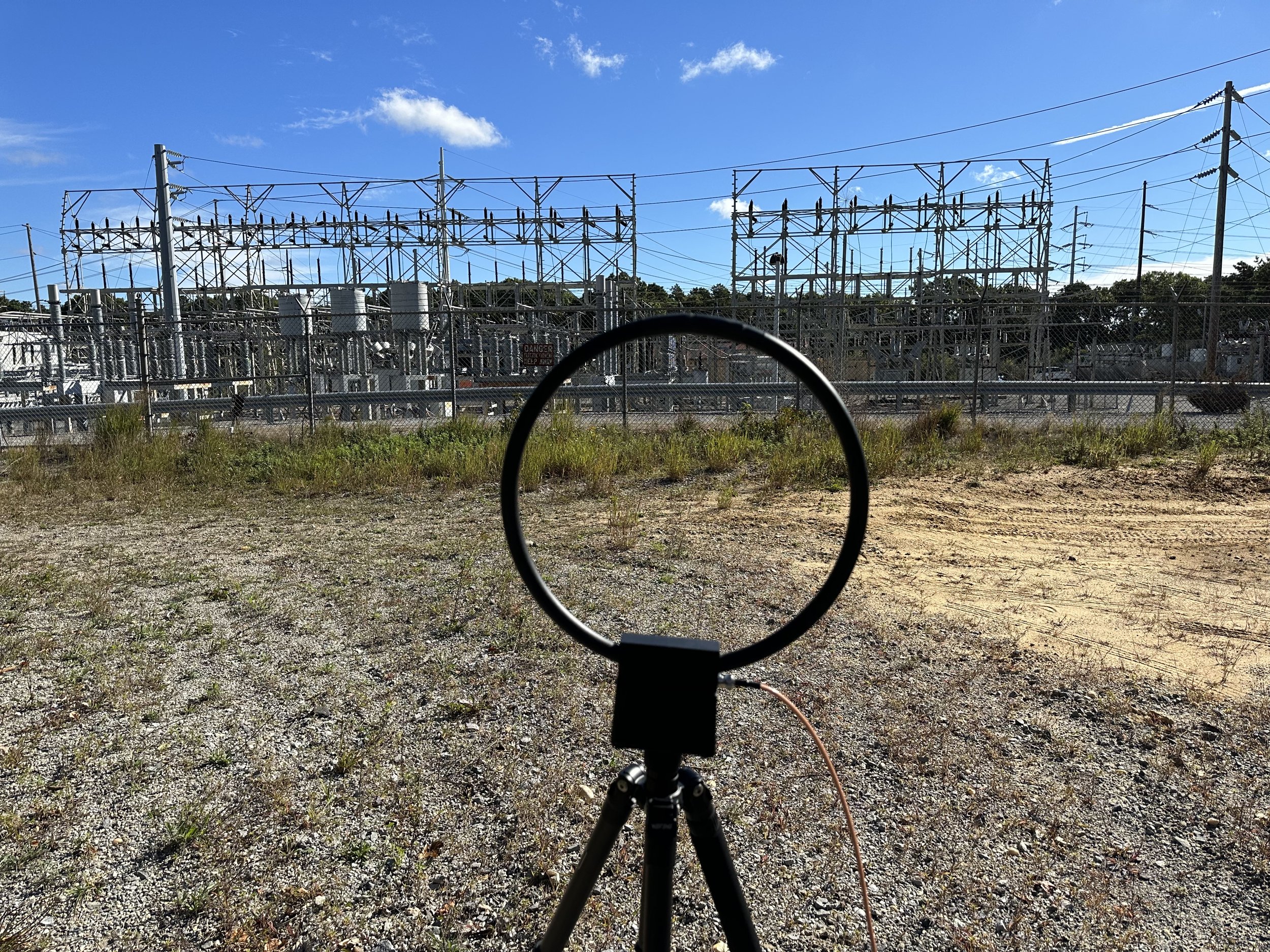
EMF Testing: What It Is and What It Isn’t
© Copyright 2026. All rights are reserved.
by James Finn, Senior EMI Engineering Consultant, Elexana
Abstract— EMF testing is the professional measurement and interpretation of electric, magnetic, and electromagnetic fields in real environments. It can involve power-frequency magnetic fields, low-frequency electric fields, radiofrequency fields, contact current, grounding-related coupling, wireless coexistence issues, and electromagnetic interference affecting electronics or people in occupied spaces. It is not a magic-reading exercise, a one-meter snapshot, or a substitute for proper engineering analysis. This article explains what EMF testing really covers, why homes, buildings, businesses, and institutions may need it, why self-testing is often misleading, when an official verifiable report matters, and why Elexana positions itself as a pioneering scientific firm in this field. IEEE and IEC standards make clear that meaningful EMF assessment requires appropriate instrumentation, validated methods, and professional judgment across a very wide frequency range.
What EMF Testing Is
EMF testing is the measurement and assessment of electric, magnetic, and electromagnetic fields in relation to human exposure, building environments, equipment behavior, and electromagnetic compatibility. Modern standards treat this as a technically broad discipline spanning from 0 Hz to 300 GHz when human-exposure practice is considered, with different methods and instruments required depending on frequency, source type, coupling path, and the purpose of the investigation. IEEE C95.3-2021 explicitly describes best practices for measurements and computations of electric, magnetic, and electromagnetic fields over 0 Hz to 300 GHz, while IEC 61786 addresses measurement guidance for low-frequency electric and magnetic fields, and IEC TR 63167 addresses contact current assessment related to human exposure.
That means real EMF testing can include, depending on the assignment:
Power-frequency and harmonic magnetic fields from electrical systems.
Low-frequency electric fields associated with wiring, grounding, and energized structures.
Radiofrequency fields from antennas, wireless systems, distributed communications, and nearby transmitters.
Contact current and induced coupling on conductive objects.
Electromagnetic interference affecting controls, communications, or sensitive electronics.
Site-specific electromagnetic conditions relevant to building design, shielding, or mitigation planning.
In other words, EMF testing is not one narrow service. It is a family of measurement and engineering practices applied to a wide range of physical phenomena.
What EMF Testing Is Not
EMF testing is not a single number from a consumer handheld meter. It is not a dramatic reading taken inches from an appliance and presented without context. It is not a broad health conclusion made from an uncalibrated device. It is not the same thing as a product-safety certification, a code inspection, a medical diagnosis, or a legal determination by itself.
Standards-based EMF work requires the right instrument for the right field type and frequency range, along with defensible procedures and competent interpretation. IEEE C95.3-2021 states that it is intended for professional users familiar with field theory and practice, as well as for those involved in critical hazard assessments or surveys. That is an important distinction. Many do-it-yourself readings fail not because the user is careless, but because the measurement problem itself is more complex than it appears. Near-field versus far-field, field orientation, modulation, duty cycle, reflections, body loading, grounding condition, probe placement, averaging method, and bandwidth all affect results.
How Broad This Work Really Is
People often hear “EMF testing” and think only of a home or a phone. In reality, the field is much broader.
A residential project may involve wiring-generated electric fields, magnetic fields from service equipment, grounding defects, nearby utility sources, wireless-device placement, and low-EMF design recommendations. A commercial office project may involve distributed antenna systems, rooftop transmitters, wireless communication failures, grounding and bonding issues, and sensitive occupants. An industrial survey may involve variable-frequency drives, motor leads, PLC upset, RF interference, shielding effectiveness, and cable routing problems. A medical-adjacent environment may involve caution with implanted medical devices, telecom installations, building systems, and the need for carefully documented measurements. Automotive and vehicle-related exposure work has its own standards as well, such as IEC 62764-1 for low-frequency magnetic fields in automotive environments.
This is why professional EMF testing is not just “meter work.” It often overlaps with EMI/EMC diagnostics, shielding evaluation, site survey methodology, and engineering design.
Why People and Companies May Need EMF Testing
There are many legitimate reasons a person, family, building owner, architect, employer, manufacturer, or institution may need EMF testing.
Sometimes the reason is health, comfort, or occupancy planning. A family may want to understand the home's electromagnetic environment before purchase or renovation. A school or office may want to assess a space after equipment changes. A tenant or employer may want independent measurements after complaints arise.
Sometimes the reason is engineering or operational. A company may have intermittent RF interference, equipment malfunction, wireless dropouts, or unexplained control-system behavior. An architect or builder may want to design a lower-EMF environment from the outset. A product developer may need site data to understand real-use exposure or interference conditions.
Sometimes the reason is compliance or due diligence. An entity may need a documented assessment for internal records, a transaction, a dispute, a permitting context, a workplace concern, or a formal technical review. In those situations, the quality of the measurement record matters as much as the readings themselves.
Why You Want a Professional to Test for You
The strongest reason to use a professional is simple: a measurement is only as useful as the method behind it.
Professional EMF testing requires more than owning a meter. It requires knowing what field quantity is relevant, what frequency range matters, what the instrument is actually measuring, how to avoid false conclusions, how to document conditions, and how to distinguish background conditions from meaningful findings. IEEE and IEC guidance both reflect that meaningful EMF assessment depends on method, instrumentation, and interpretation, not just device possession.
Self-testing often goes wrong in predictable ways:
using the wrong meter for the field type or frequency,
taking readings at inconsistent distances or orientations,
misreading transient peaks as continuous conditions,
failing to distinguish ambient RF from near-field leakage,
ignoring wiring, bonding, or contact-current contributions,
and drawing mitigation conclusions before identifying the real source-path-victim relationship.
A professional is also valuable because they can tell you what does not matter. That is often just as important as what does.
When You Need an Official, Verifiable, and Replicable Report
Not every EMF inquiry needs a formal report. Some projects only need consultation, planning, or a focused diagnostic visit. But there are situations where an official, well-documented, and replicable report is the right tool.
You generally want a formal report when the measurements may be relied on by:
a homeowner or buyer making a major purchase decision,
a builder, architect, or engineer planning a design response,
an employer or property manager addressing occupant complaints,
legal counsel or insurers,
a medical, institutional, or industrial client,
or a company needing internal or third-party technical documentation.
A report becomes especially important when the result must be repeatable, reviewable, and defensible. That means the report should clearly identify the measurement date, instruments used, calibration status, methodology, locations, conditions, and findings so that another competent professional could understand how the conclusions were reached. That level of rigor is part of what separates engineering-grade EMF work from informal readings.
Why Elexana Positions Itself as a Pioneering Company
Elexana’s distinction is not that it claims EMF testing is simple. Its distinction is that it treats the subject as the technically broad discipline it actually is.
Rather than reducing EMF testing to a single consumer metric, Elexana approaches it as a combination of scientific measurement, electromagnetic engineering, site-specific interpretation, and mitigation strategy. That means homes, buildings, electronic products, RF environments, grounding-related problems, shielding questions, and interference issues can be evaluated as parts of one larger electromagnetic reality rather than as disconnected topics.
Elexana also emphasizes unbiased scientific testing, calibrated instrumentation, and verifiable reporting. In a field that can easily drift into oversimplification, this matters. The companies that set standards in practice are not the ones with the loudest claims; they are the ones that produce measurements and reports that engineers, clients, and decision-makers can actually rely on.
For that reason, Elexana regards itself as a pioneering company not because it narrows the field, but because it works across its full scope: EMF testing, RF interference investigation, EMI/EMC diagnostics, site surveys, shielding evaluation, mitigation design, and technically defensible reporting.
Conclusion
EMF testing is real, important, and much broader than most people realize. It includes low-frequency fields, radiofrequency environments, contact current, interference, exposure-related measurements, and the built environment itself. It is not a one-device shortcut, and it is not well served by guesswork.
When the result matters, the right approach is professional, calibrated, documented, and replicable. That is especially true when people are making health, financial, legal, operational, or engineering decisions based on the findings.
At its best, EMF testing is not about fear. It is about clarity. And clarity requires good science, good instruments, and good judgment.
References
[1] IEEE Standards Association, IEEE C95.3-2021, IEEE Recommended Practice for Measurements and Computations of Electric, Magnetic, and Electromagnetic Fields With Respect to Human Exposure to Such Fields, 0 Hz to 300 GHz.
[2] International Electrotechnical Commission, IEC 61786 series, Measurement of DC magnetic, AC magnetic and AC electric fields from 1 Hz to 100 kHz with regard to exposure of human beings.
[3] International Electrotechnical Commission, IEC TR 63167, Assessment of contact current related to human exposure to electric, magnetic and electromagnetic fields.
[4] International Electrotechnical Commission, IEC 62764-1, Measurement procedures of magnetic field levels generated by electronic and electrical equipment in the automotive environment with respect to human exposure – Part 1: Low frequency magnetic fields.